Affection for Artifacts
The article cost's (1) less to read for each artifact you love

In my introductory article I hinted at my love for a specific card from the Mirrodin theme deck Bait & Bludgeon and told you I wanted to talk about it. If you didn't read through that article, fair. It was kind of everywhere. I'm trying to do “more gooder” at this writing thing, but don't get your hopes too high quite yet. Wait! Come back!
Okay, okay. Let's get on with it then.
Big. Blue. Broodstar.
Let me set the stage a little: It's 2003 and little nine-year-old me has just been given a pack of cards by my probably-too-encouraging father, both of us unaware of the impact Magic: the Gathering would have on my life. My dad isn't really a nerd. He's a very smart man, PhD, all that, but not into games, pop culture or any of that stuff. But me, I am. I was elected "Most Likely to Become a Dragon Slayer" out of elementary school, I’ll have you know. Of course, I got mad they hadn't said "Dragon Rider."
So my dad got me Magic cards and let me loose to play with friends, not knowing it would turn into a cornerstone of my identity or how much money I'd be willing to spend on cardboard rectangles (quite a lot, it turns out). Bait & Bludgeon was my second theme deck, built around Mirrodin's affinity mechanic. The original artifact lands, a slew of myr, Frogmite, and the scales and teeth of Chiss-Goria drove a lightning fast, highly synergistic strategy that, as I later found out, terrorized Standard in it's time. So much so that Julian Nuijten won the 2004 Pro Tour by specifically hating on affinity. Looking back, it seems like a wild time to have been playing competitive Magic.
Bait & Bludgeon's top end was a ten mana beast, a beefy flier with power and toughness equal to your artifact count and, crucially, affinity for artifacts. Broodstar.
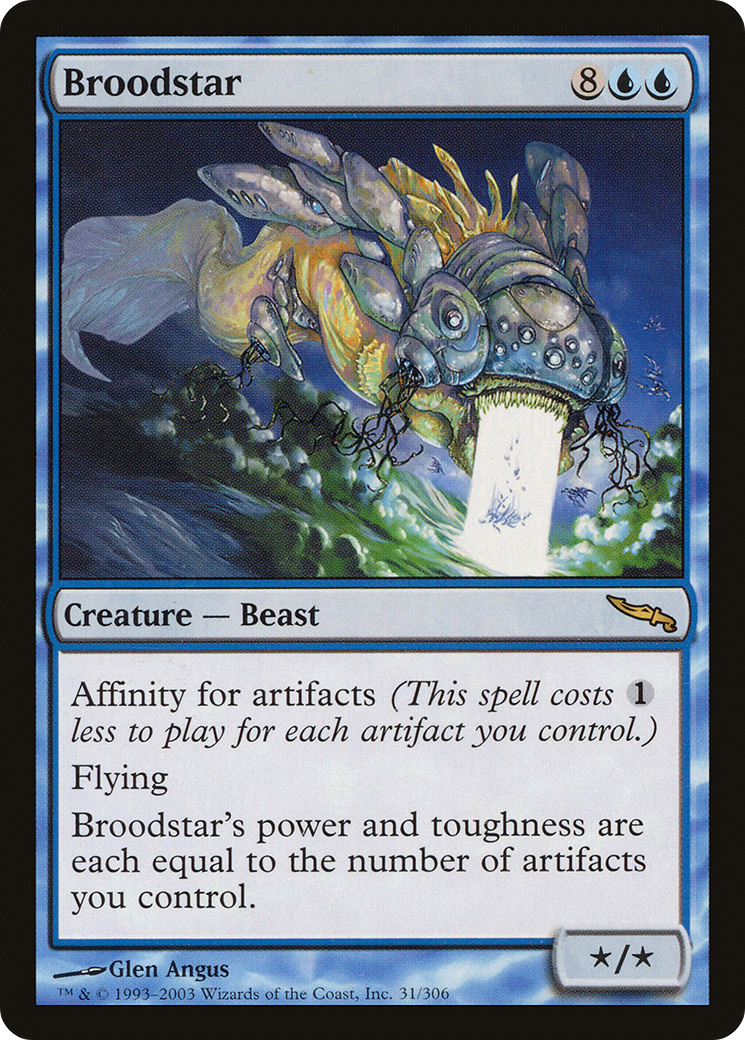
By today's standards this card isn't playable: it has no protection and affects the board very little the turn it comes down. It isn't even an artifact itself, so if played to an empty board it simply dies. That said, I adore this behemoth like no other card in Magic. My affection for it is so deeply ingrained in me that it was one of the first singles I bought when I got back into Magic.
That return came almost two decades after original Mirrodin. A coworker-turned-close-friend invited me to play EDH, and besides an Streets of New Capenna Commander precon (Maestros Massacre) the first deck I built myself was a Dimir affinity deck. I somehow came into a copy of Tezzeret, Master of the Bridge and Rule Zero-ed him into the command zone but quickly found out why planeswalkers make for bad commanders. I switched instead to Silas Renn, Seeker Adept, and began rotating through different partners trying to find the right fit to capture that affinity feeling.


The many iterations this deck has gone through have helped me settle on something. I've been chasing a nostalgia I’ve not felt since playing Bait & Bludgeon as a kid. These partner decks have gotten part of the way there, but they’ve always felt clunky, with none of the synergistic qualities I crave. All I want is a blue/black affinity deck where I can play my favourite cards, and in reality all I want to do is stick Broodstar in the command zone.
There's a couple problems with that though. Broodstar, a massive, ten mana beast, a creature with a one word name that is clearly it's name, and a beefy rare from a mainline set, isn't legendary. Also it's mono-blue, so, you know, no black in sight. So today let's examine my favourite card in Magic, learn about it's history, perhaps where it came from, and what it might take to elevate it to legendary status.
Legends? What Legends?
Mirrodin actually had very few legends, five in total, and of those only Bosh, Iron Golem and Glissa Sunseeker were creatures. Broodstar was printed well before Wizards of the Coast began churning out legendary creatures at the pace they do today, so it's little surprise it got snubbed the legendary supertype. To elevate it to legendary status we need a title, something like what Bosh and Glissa got. And for that we've got to learn about it, dive into it's origins, and discern it's role within Mirrodin's ecosystem (the plane, not the set).


I won't recount the full history of Mirrodin here. Trust me, I don't need to pad out this article any more than I have. Check out the wiki page if you want to learn more. Suffice it to say: Broodstar isn't from Mirrodin and didn't always look the way it did. In fact, nothing organic on Mirrodin was from Mirrodin. The Krark-clan goblins, the elves of Tel-Jilad and vedalken of Lumengrid, the Nim and the Auriok tribes, they were all stolen from their homes by the plane's insane tyrant, Memnarch. Many of these unwilling inhabitants, though mutated by mycosynth, can have their origins traced to other realms, but Broodstar seems to have no predecessor in Magic. There's no art I can find and point to as it's origin, though a few come close.
Odyssey's “thought beast” cycle has visual qualities that imply shared genetics with Broodstar. Jim Nelson renders a Metroid-esque jellyfish in Thought Devourer, with an irregular hide suggesting barnacles and haphazard tentacles ensnaring it's most recent victim (not to mention absolutely peak flavour text). Luca Zontini's Thought Eater is instead more like an eel with arms, though seems to prefer it's split, whip-like tails for capturing prey.
The most gruesome of this cycle is Arnie Swekel's Thought Nibbler. Unlike it's larger relatives, the Nibbler grips the scalp of a Balshan wizard (so we learn from the flavour text). Parasitically, it clings with fleshy, arachnophobia-inducing legs and burrows, leech-like through the skin and skull. The blasé expression on the wizard's face belies no pain at the rather, shall we say, invasive procedure. The lack of reaction even to the Nibbler's stray tentacle seeking his ear canal is enough to make the viewer squirm in sympathetic discomfort.


Kev Walker's rendition of Mawcor, a rare from Tempest, also has much of the DNA visible in Broodstar. The rows of sharp teeth, elongated body and gargantuan size make for a close cousin for Broodstar, save that it has two heads (and more fantastic flavour text). Keith Parkinson's Ephemeron has similar parallels: elongated body, huge size, and the flavour text implies rows of teeth not visible in Parkinson's rendition.
Cognivore, printed in Odyssey two years earlier, has a lot of the same templating as Broodstar. The two share near-identical mana values, fly, and grow in power and toughness depending on a card type. The toothy maws of both creatures are similar, rows of dagger-like teeth and all, and the Cognivore's curling horns see reflection in the mycosynth plating off the back of Broodstar's head. The llurgoyf's body it long, extending out past the paintings frame, and elements of it are shrouded in mind-numbing fog. It's arms seem withered, perhaps atrophied by it's perpetual flight and psychic diet. What good are hands when your nourishment is thought and your prey is helpless? One could imagine the llurgoyf being snatched from it's home plane by Memnarch and morphing into Broodstar, it's voraciousness for thought being replaced with one for metal by mycosynth corruption.


Admittedly, this is a long shot. Cognivore's artist Adam Rex (who is awesome by the way) couldn't recall any connection between the two. Tragically Glen Angus, Broodstar's original artist, passed away in 2007, so it's origins and the origins of many of his works may remain forever a mystery. Hints exist in Broodstar's predecessor's, but there's no clear origin. Without a history, we can then only look at the beast's contemporary, that of Mirrodin as we first saw it in 2003.
Lemons from the Quicksilver Sea
So you just read 1000 words and it turns out, surprise! I've got nothing. I guess that means I can just do what I like, which is nice. When life gives you lemons, make Magic cards!
Obviously, this article couldn't keep going if I had nothing. We've got something to work with at least. There's all kinds of art to reference, books published, and community wikis to trawl through. Nothing concrete though, so we'll be moving forward by making a lot of assumptions.
First, Broodstar is blue. Within Mirrodin (the set) that associates it with Lumengrid, the seat of vedalken power out in the Quicksilver Sea. It also places it with the drones, a subset of creatures in the set created by the vedalken as guards and sentries. If we look closely at Angus' painting for the card, we can see it appears to be hovering over a surface that looks remarkably like liquid mercury. Let's assume then that it lives somewhere in or around the Quicksilver Sea, and perhaps in proximity of Lumengrid.
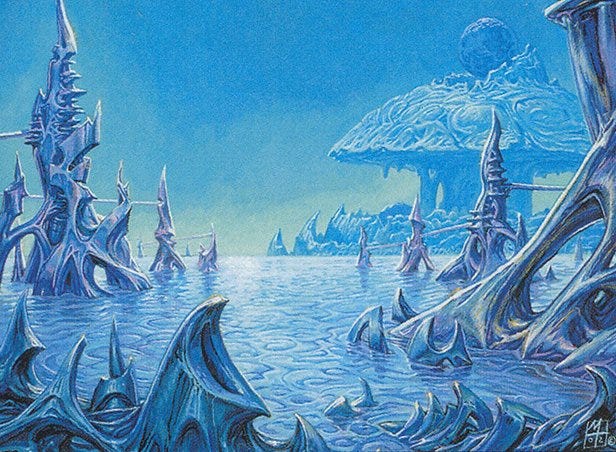
Broodstar also appears to be a predator of some kind. It emits a kind of energy beam, rendered in platinum white, to obliterate prey and then, I assume, consume what remains. Others of the unfortunate victim’s flock circle about, wheeling into the air to escape annihilation. While their nature is as uncertain as Broodstar's, they look to be something similar to Edward P. Beard, Jr.'s Neurok Familiar or Alan Pollack’s Neurok Hoversail. With the Neurok and Vedalken Empire often at odds, vying for control over the Quicksilver Sea's waters (metals?), I imagine Broodstar as a sort of kraken, leashed by Lumengrid to guard it's borders from unwanted trespassers.


In fact, Will McDermott's companion novel to the set, The Moons of Mirrodin, contains a few passages that suggest something not unlike Broodstar guarding the sea around Lumengrid. Admittedly, the creature in McDermott's novel is formed of pure quicksilver, but it’s presence in the story (encountered as Glissa and friends attempt to sneak into Lumengrid) suggests a relationship between the vedalken and creatures of the Quicksilver Sea.
It was a huge blob of silver at least ten feet tall with tentacles waving out in front of it. - The Moons of Mirrodin, p. 258
[Bosh] was completely wrapped up in tentacles. They encircled the golem's torso like the leather rope that tied Bosh to the diver. - The Moons of Mirrodin, p. 258
So, Broodstar likely lived in or above the Quicksilver Sea, seems to have fed on creatures mutated by mycosynth, and was perhaps kept in check or maybe corralled by the Lumengrid vedalken. It was probably a kind of apex predator on the sea, but fed on smaller, less aggressive prey. I imagine it like a whale, filtering krill from the oceans, or perhaps some kind of gargantuan detritivore, cleaning up carcasses that had come to rest in the mercury waves. Given this, I think I've got a couple ideas for names.
Raising the Bar
The other, less pressing and much stickier challenge of legendifying Broodstar is it's relative power level. This is a card from 2003 that is, as many EDH players would call it, a "do nothing." To be a proper commander, one worthy of the legendary supertype, we need to bring it up to speed with modern power. That said, we need to be really, really careful here. I actually want to play this deck, so I need to ensure this thing can't easily combo off and doesn't scream "I'M BUSTED AND THIS IDIOT IS BREAKING THE GAME" to the rest of the table.
The first place I can think to look for ideas is the old Bait & Bludgeon deck. What other cards might I be able to emulate here that can give Broodstar a little more oomph? The only truly black cards in the original decklist are Nim Shrieker and Irradiate. Broodstar already does what Nim Shrieker does (but better), but Irradiate gives me a couple ideas.


We can also look to the other black cards in Mirrodin for inspiration. the rest of the Nim stand out thanks to the artifacts-matter theme, as does Disciple of the Vault. I'm quite wary of doing anything approaching Disciple because of the combo potential, and the Nim are frankly a bit underwhelming. Let’s try something else instead and look to the rest of Mirrodin block for some ideas.
Darksteel has a few cards that give me ideas. Emissary of Despair is really cool, but I don't think I need that kind of effect on Broodstar when it already gets huge. Scrounge, however is a very neat card I'd not come across before. I love a good theft mechanic, and something that can nab my opponents artifacts from their graveyard pushes the deck in an interesting direction. I also like the interactive nature of it and how it might engage my opponents in-game.
Nothing among the black cards from Fifth Dawn jump out to me, though Cranial Plating has some interesting possibilities. It's little surprise though, that so few cards stand out as contenders for an artifacts-matter ability I might plaster haphazardly into Broodstar's text box. As Mark Rosewater himself has pointed out:
For those that don't know their history: the Mirrodin block ended up being a very broken block, one of the most broken blocks in Magic history. …So, one of the things we kinda knew going in on Fifth Dawn was "Oh, well there's a whole bunch of things we need to be careful about." Things like: artifact matters, powerful artifacts, most of our mechanics. Uh, so, we started Fifth Dawn saying "Hey, we want you to be an inclusive part of the Mirrodin block, just don't do most of the things that Mirrodin did." - Magic: The Gathering Drive to Work Podcast episode #936: Fifth Dawn, Mark Rosewater, 2022


Fixing my Mana
The last thing I want to do here now that I've got a couple ideas is to sort out Broodstar's mana cost. If I'm going to put an extra little something on it, I feel the need to make it a little trickier to cast so I can't just turbo it out for a cool two blue as early as possible. There's got to be a give and take. In that respect, I think there's a couple, simple options.
Whatever ability I give it also has to have some kind of cost associated with it. An attack trigger is easy, but a combat damage trigger is, I think, pretty cool. I also like the flavour of Broodstar as a predator, so some way of putting that on the card would be neat. I'd like to feed it artifacts to activate whatever ability it has. That also brings in an interesting dynamic of sacrificing artifacts to do stuff, but not too many or it might shrink Broodstar to the point where it can't effectively attack. Again, give and take.
All that said, here are two versions of the card I think are neat. What do you think? Is there anything I missed, or other ideas I didn't hit on?


And tell me what you liked and/or didn’t like about the article! I'm really new to this kind of thing, so I'm all ears to healthy, constructive criticism.
Finally, thanks for reading! I hope you enjoyed coming with me on this little journey, as meandering as it was. Next time I think I want to talk about some really spooky ladies, so stay tuned for that.
- VA
I LOVE the idea of “Legendarifying” quasi-legendary creatures, especially one as memorable as Broodstar. I’m very poor at judging design balance, but I think I prefer Broodstar, the Mycovore, because the flavor of decimating a single creature matches Broodstar’s Godzilla-style vaporizing ray.
Keep up the good work!
Thanks so much! I don't know how much more legendifying I might do around here, but it was a really neat exercise. Broodstar is such a personal card for me, so it was a great opportunity to dive deep on it. It really does fit into the Kaiju mold super well. A Godzilla vs Broodstar movie would probably be sick as hell!