Loot, the Sequel
More about a little guy and what it all means

Welcome back. This is Part Two of me talking about Magic: the Gathering's newest mascot. If you missed Part One, you can read it here. I recommend it not just because I wrote it but because this article is going to be building on and referencing what I talked about in that article. If that sounds like too much work though, here's a little recap.
Loot is the newest face of Magic, following in the footsteps of former "main characters" that failed to be marketable. His creation and visual design were clearly inspired by characters like Pikachu, Kuriboh and Teemo, and the narrative elements assigned to him allow Wizards of the Coast (WotC) to do all kinds of things design-wise. His cards are designed to be intentionally powerful and his associations to the colour pie communicate hope, wonder, excitement, and observation.
Today I'm going to be taking all the information from Part One and trying to synthesize it down into core themes. Very quickly, the themes I think are relevant are:
Loot as a Surrogate,
Loot as a Bridge,
Loot as nu-Magic, and
Loot as a Roadmap
We're going to dive into each of these here in a second, but first there's something I forgot to mention in Part One that's kind of important.
Where the Omenpaths Aren't
There's a final aspect to the whole situation around Loot that involves Magic's brand: Universes Beyond. For better or worse, Magic's own intellectual properties, it's rich and storied characters and worlds, are taking more and more of a back seat as the game develops. Since 2020 when Secret Lair: The Walking Dead kicked off the influx of non-Magic IP in the game, UB products have taken an increasingly large slice of the product pie.
Most of these have been justifiable for the game, but some have felt otherwise out of place. For every Stranger Things or Lord of the Rings crossover we get, there's a Fortnite, Assassin's Creed or SpongeBob SquarePants counterpart. I generally welcome these products as an in-road for new players and as a way WotC can capture new audiences and help them engage with this great game. However, 2025 heralds a major shift in attitude towards UB products, both from the playerbase and WotC.
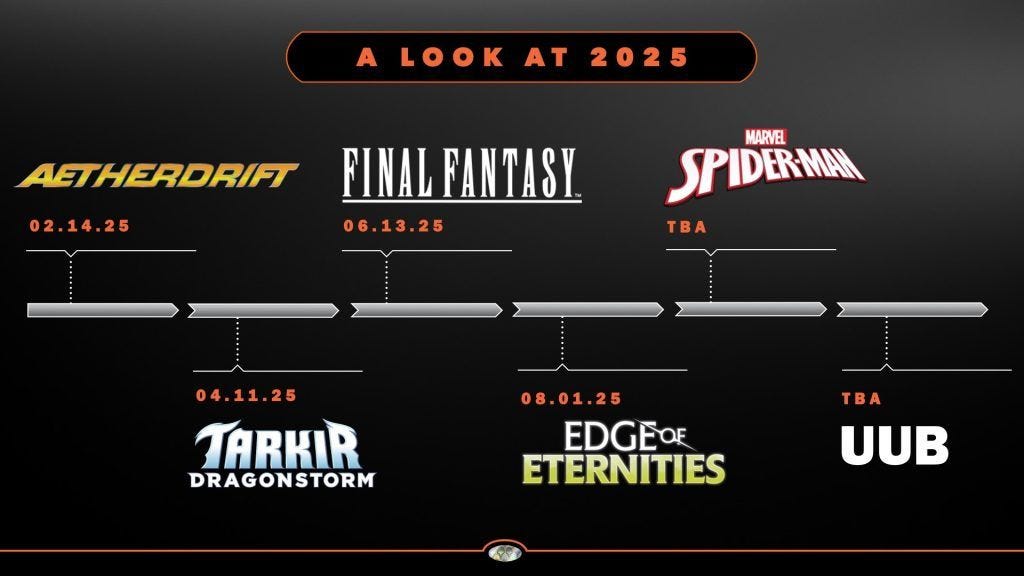
There are six full sets slated for release this year, all of which will be legal in Standard and eternal formats. Half of those are Universes Beyond products: Final Fantasy in June, Spider-man in September, and Avatar: the Last Airbender in November. Though it's disappointing to see Magic's own worlds being shoved aside (our return to Lorwyn was pushed back to 2026 to make room for UB sets) this in itself shouldn’t really be an issue. People are excited for Final Fantasy and Spider-man, and I'd be really stoked for Avatar, except for the pricing. From WotC's First Look article:
MSRPs for Magic: The Gathering—FINAL FANTASY will be set as follows:
Play Booster: $6.99
Collector Booster: $37.99
Commander Deck: $69.99
Collector's Edition Commander Deck: $149.99
Bundle: $69.99
Gift Bundle: $89.99
Starter Kit: $19.99
$6.99 for a Play Booster? 70 bucks for a Commander deck? What are they smoking?! Unfortunately it's been confirmed that these price tags will also be on Spider-man and Avatar products, so I'm off UB hype. Maybe Avatar gets me to break out my wallet, I do love that franchise, but I'm making a conscious effort to only buy Magic IP sets this year. Tarkir: Dragonstorm honestly look sick, and Edge of Eternities has Tezzeret in it so must be good.
With the deluge of UB products, Loot gives us a glimmer of hope. My read is that WotC—and by extension Magic—stands at a Dramatic Crossroad. Down one path is a celebration of Magic's native IP, down the other a celebration of foreign IP. I won't lie and say that I think both sides are equal; they aren't. I would vastly prefer the former over the latter, and I believe strongly that the driving force behind the game's success has been it's creativity and innovation. In that vein I believe that whether players embrace or reject Loot will be one way WotC measures success this year.
Loot is possibly the last gasp of creativity from the company, a final attempt to break into the mainstream with it's own IP. Then again he may not be, we can't know until the dust settles on 2025. In the meantime I'm going to embrace the little guy, welcome him in with open arms, grit my teeth and smile while repping his merch. Is he perfect? No, not even close. But he's ours. He belongs to Magic, and Magic alone. This is our mascot now, and I for one prefer the rule of an imperfect beast noble to colonizers from universes beyond our own.
Loot, Surrogate Son
Alright, with the elephant out of the room, let's talk about that beast noble. I've been thinking about him a lot, probably too much if you ask my friends, and I've noticed a bunch of interesting themes throughout the stories and cards he features in. Let’s start with a simple one: Loot as a surrogate.
Loot's place in Magic's narrative is very explicitly as the surrogate child of Vraska and Jace. In the same story we first meet Loot, the two of them talk about adopting a child, and Jace refers to Loot and Vraska as his family at multiple later points in both the Aetherdrift and Tarkir: Dragonstorm stories.
What is next? Jace remembers his mother's question, is that your wife? The vision he holds of her in Vrynian formals, his family's blues and patterns complementing the green of her skin. He imagines a child of their own. The look in her eyes says that she imagines a similar future.
"You'd make a phenomenal parent." She says.
"So would you."
"We'd need to …"
"Adopt," Jace says quickly. Then smiles with a blush. "I don't think it would work."
"Adopt," Vraska nods quickly, wincing an acknowledgment, "I think we'd know by now if it did."
This excerpt from Alison Luhrs’ Outlaws of Thunder Junction | Epilogue 2: Bring the End, Part 2 tells us that Loot is intended to stand in for their biological child, and the couple fosters him as their own as a result. There's additional subtext here, of the older generation of characters raising and nurturing the new—a sort of passing of the torch. Chandra falls into a similar role in the Aetherdrift storyline, and appears carrying Loot much like a toddler in art for Full Throttle. While she and Spitfire strike at an unseen adversary tag-team style, Loot grins gleefully from within the pyromancer's jumpsuit. All the art lacks is an actual baby carrier to complete the look.
Eggnogger's 'Stache portrays Loot as an elated child at Christmas dinner, happily chugging festive drinks with little care for decorum. He is every kid who's ever been allowed a little wine or been told they can open one present on Christmas Eve. Here he is a surrogate for the viewer, allowing some of us to recall a nostalgia through his euphoria.


More broadly, Loot fills the space in Magic's marketing where a Pikachu or Kuriboh might go. Not having a cute, fuzzy mascot from the games inception, Loot becomes its adopted one. It's obvious from looking at him he's not the biological offspring of the game, and one would be forgiven for thinking he belonged among the Universes Beyond characters. None the less, he is of Magic, and Magic will treat him as a son.
There are additional hints at Loot's surrogate nature in the mechanics of his cards as well, which brings me to the next major theme…
Loot, Bridge of Eras
Loot represents a bridge between Magic of old and new. This is most obvious in Loot, the Pathfinder. I talked about this in Part One, but I'll recap. Pathfinder has three abilities, each representing mythical cards from Magic's past: Black Lotus, Ancestral Recall, and Lightning Bolt. Pathfinder takes three of the most powerful effects in the game and synthesizes them onto a single card, along with a solid 2/4 body. The cards design clearly communicates the titular character's position in the game's history: taking the old and bringing it into the modern age.
His nature in the story is evidence of this too. Loot was found in the Fomori Vault, called Maag Taranau by the locals of Thunder Junction. He was held in stasis within this artifact for unknown millennia, with a mural of a Fomori above him. "But what the hell is a Fomori?" I hear you asking. Unfortunately, we know little of the Fomori except what can be gleaned from a handful of cards.
The Fomori were the primary race of a Multiverse-spanning civilization that predates most of Magic's canon. This Coin Empire, as the in-universe researcher Quintorius Kand has tentatively called them, apparently conquered and colonized many planes in their time. Said to originate from Ir—an obscure plane only ever featured on a single Planechase card—their members only ever featured in the art of two cards and a token. Notably, Fomori Nomad was printed in Futuresight, a set meant to forecast the future of Magic.
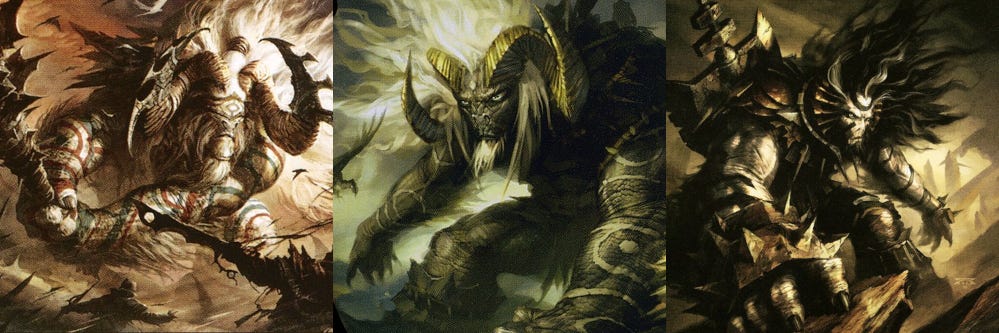
Raymond Swanland’s renderings of the Fomori boast gargantuan statures compared to Loot, appearing as kaiju-sized oxen rather than cute and cuddly, but his lineage is obvious. The horns and geometric patterns on their hides, combined with the context of his discovery by Jace and Vraska, mark him as the last child of a dead empire. He is an oxymoron, an ancient infant brought into the contemporary narrative, a character outside Magic's typical visual design but wholly of Magic, and his cards attempt to marry nostalgic, mythical cards with modern design. Too bad he didn't inherit nostrils from his ancestors.
Loot, nu-Magic Bannerette
Speaking of modern design, I've been harping on this idea of nu-Magic. It's about time I explain myself, I think. What, exactly, do I mean by nu-Magic?
Magic: the Gathering has been in print now for just over 30 years and has changed dramatically in that time. What was once a game characterized by enigmatic mechanics, slapdash design and cult followings has been honed into a tight, synergistic product engineered to make money. Part of that strategy has brought about a distinct shift in design.
Nu-Magic attempts to encapsulate the shift in relative power post-FIRE Design, the increased focused on marketability and efforts by Hasbro to increase the games profit share. We live in a novel era of Magic design, where cards have little space for flavour text and each set brings with it new, broken designs to serve as chase cards in packs. We've seen "shrink-flation" as booster boxes go from 36 to 30 packs, turbulence in limited formats with increased variance in packs, upheaval in "non-rotating" formats like Modern, and now Universes Beyond pricing affecting Standard. Cards do more now than they ever have, and more of them create a 2-for-1 outcome more often. This is nu-Magic. This is the philosophies that gave us Trouble in Pairs, Up the Beanstalk and Nadu, Winged Wisdom, six Standard sets and 30 Commander precons a year and themed sets featuring fedoras, Stetsons and motorcycle helmets.
Gone are the days of vanilla creatures, Doomblade-level removal and basic lands, come is the age of nu-Magic.
Loot embodies these new ideals. His visual design is that of a League of Legends character, he is quite literally a new character in the game's narrative, and he is being fostered within those stories by the old guard: Jace, Vraska, Chandra, and as of Tarkir: Dragonstorm Narset and Elspeth. The mechanics of the cards he features in further evidence his role in nu-Magic philosophy.
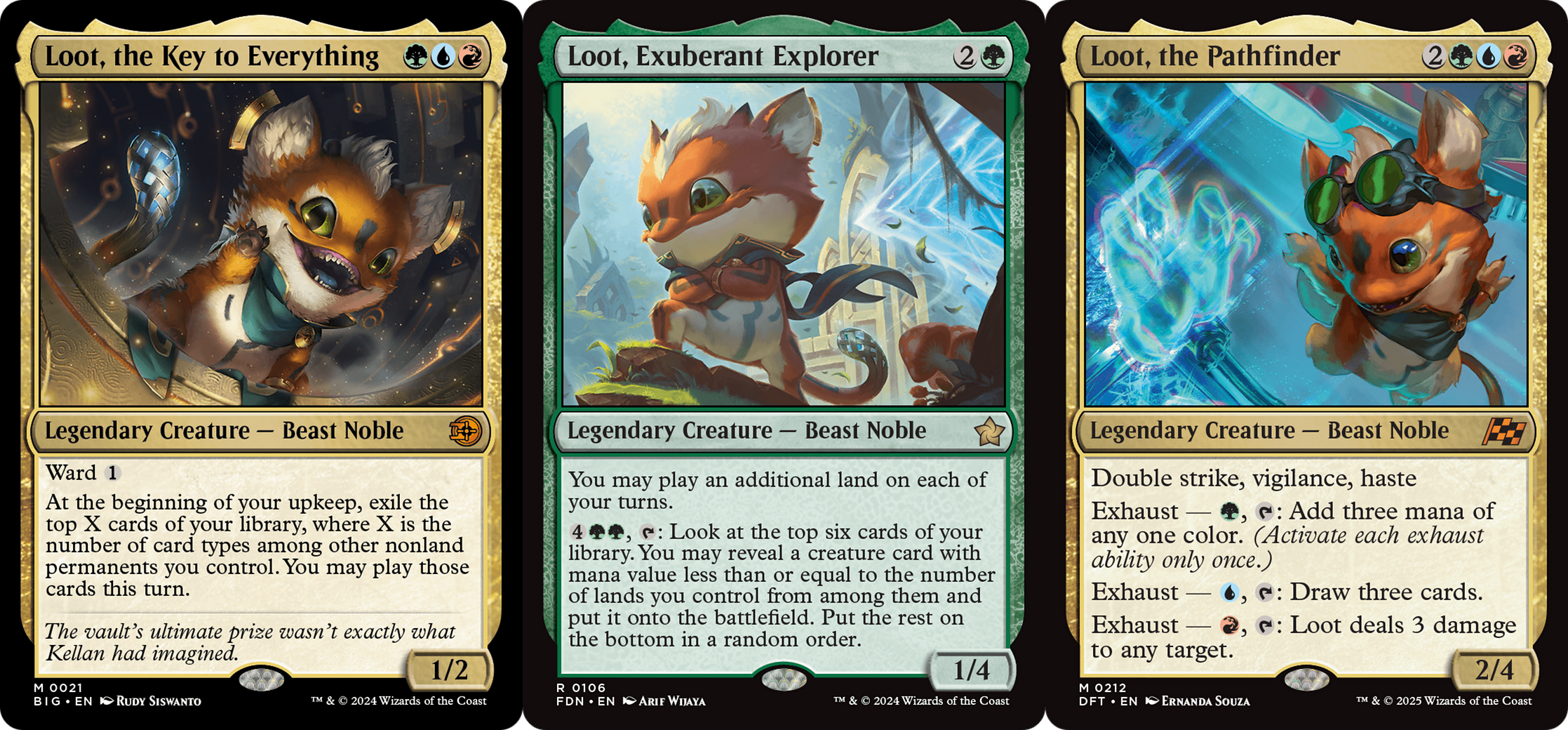
I've already talked at length about Loot, the Pathfinder's activated abilities, but it's keywords are notable in the context of nu-Magic. The simple fact that it has haste means you are all but guaranteed to get some value out of it by attacking and/or activating one of it's exhaust abilities, whereas ten years ago this card would've had to survive a turn cycle first. Vigilance doubles down by allowing you to attack the turn it's played then activate an ability as well if you've got open mana.
Loot, Exuberant Explorer offers another kind of advantage, letting you play extra lands and finding you creatures from your library. It’s also a decent body to block with, four toughness putting it out of Lighningbolt range. Loot, the Key to Everything is probably the weakest of the three, having to survive a full turn cycle to impulse draw you cards. Luckily it comes with built in protection (ward 1), and the minimal threat it poses to your opponent’s gameplan means they're likely to ignore him.
What's stands out to me about Pathfinder, Key and Explorer is the amount of text on each card. Only Key leaves any room for flavor text—and only two lines at that—so we stand to learn little about Loot as a character from the cards themselves. Many Magic players skip reading WotC's published stories and are only introduced to characters and worlds through the 3.5x2.5 inch cardboard windows they play with. When images tell little—where is Explorer, or Key for that matter? What's with the ghostly hand in Pathfinder?—we rely on the names and mechanics of cards to engage with the game's lore. The increasing complexity of rules text and endangered habitat of flavour text is another aspect of nu-Magic, one evident on Loot's cards.
Loot, Map to Anywhere
Right, the home stretch. This is the biggest idea to tackle and could frankly be it's own article, but at this point I've talked myself blue in the face about Loot and my psychiatrist says I need to stop.
Loot has a special superpower, a sixth sense that lends him relevance in Magic's stories and long-term narrative arc. He has within his little-guy cranium a real-time map of every plane and Omenpath in the Multiverse. For his allies, this means he can point them to the nearest shortcut, escape route or bypass with 100% accuracy. For WotC, it means they can use Loot to take us anywhere in the Multiverse they want to go.
As I said in Part One, Loot becomes Doctor Who's TARDIS: a pseudo-magical vehicle to justify any setting or story the writers can imagine. If WotC want's to take us back to Bloomburrow, Alara, Shandalar or Innistrad, Loot can take us there. If they want to go to planes we've not yet visited like Iquatana, Fiora, Vryn or even the Fomori homeland of Ir, Loot can do that too. If WotC wants to make new planes we've not been to with top-down designs based on the Amish, basketball, VeggieTales, or My Little Pony, they can. And as long as Loot is in the game, he can do that indefinitely. He provides a map to the Multiverse, but also the possibility of a truly endless story for Magic.
There are some metatextual elements to Loot's internal map as well. WotC has positioned him to be the next face of Magic, putting him on various products, making him the prize of Maag Taranau, giving him a pivotal role in the non-block block structure of 2024 and 2025's tentpole sets, and printing extremely powerful effects on his cards. Giving Loot this Omenpath-sense and real-time Multiverse map indicates how WotC views him in the context of the company's future. This is only a theory, but I strongly believe they perceive him as a roadmap for the company as a whole, and his superpower implies that.
Loot's role as a guide is obvious in the art of Omenpath Journey and Point the Way. Omenpath Journey positions him as a leader, guiding with confidence his adoptive parents to some unseen destination through what looks like a field of lotus'. Point the Way breaks through the fourth wall, placing him instead as the player's guide through the Omenpath ahead. While I’m focused on the art here I'll point out again that these cards leave no space for flavour text, being too mechanically complex to communicate more than their function.


The little guy appears finally on the cycle of verges from Aetherdrift, each time either hurtling towards or diving out of an Omenpath. If one looks closely they might deduce that the locations on either side of the portals are planes from Aetherdrift—Avishkar, Muraganda, and Amokhet—but these are tiny, easy to miss details. The cycle does leave space for flavour text, each one giving us insights into other characters' impressions of Loot. Winter's remark on Willowrush Verge feels stranely out of place given cruelty towards Loot in the Aetherdrift stories. These quotes further characterize Loot as childish, remarkable, special, brave, curious and naïve, and the popularity of these lands ensures players will be seeing Loot's face and name for many years to come.


Denouement
Sweet Baby Ray's Barbeque Sauce, it's done. You made it. We made it. I've been thinking about Loot for way too long, and I can finally stop. Except I probably won't, so you can anticipate another one of these once there's more to talk about.
As I see it, Loot fills the marketing gap Magic has long lacked, bridges the space between old magic and new both narratively and mechanically, carries the banner of modern, nu-Magic card design, and contains a roadmap to the game's entire universe and future. He is the embodiment of everything the company has worked towards for years and will be the future of the game for years to come. While I'm not yet sure what they have in store for us or have planned for Loot, it's clear to me he will be at the crux of whatever and wherever we end up.
Before I go, let me caveat everything in my last two articles: This is only my perspective on things. There's any number of other conclusions one could draw from Loot's contextual elements, and any one of them is probably only half-right. If you've got another take or additional insights, I'd love to hear them. I know for a certainty I've missed things.
Anywho…
Thanks for coming to my TED Talk
-VA